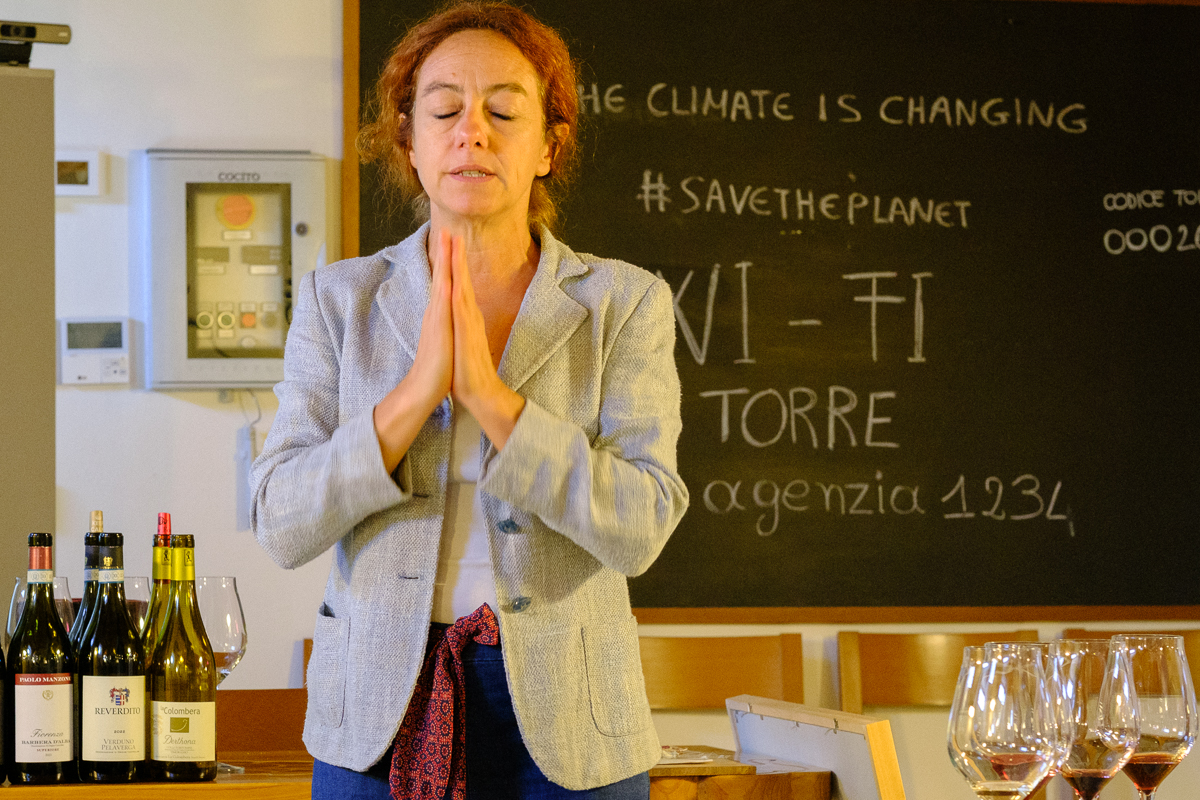
Outside of the silliness of a Republican presidential primary debate, it’s getting harder to find people who deny the existence of climate change. If you grow stuff for a living, you can’t afford the luxury of climate change denial. In the Piedmont region of Italy, the subject of climate change came up at every winery we visited. How the wine makers adapt to climate change will determine whether or not they stay in business.
Elizabeth told us that the Piedmont wine region may be more affected by climate change than any other in the world. The climate has become drier overall, with less snow in the winter. Vineyards here are not irrigated, but get their water from the “old” climate’s adequate rainfall. Now, when it does rain, it often comes in extreme downpours and quickly runs down the slopes. Erosion is a problem, and hail has become more frequent, sometimes destroying vines.
We learned of the various ways wine producers are responding. Some producers are buying land at higher altitudes for the future planting of Nebbiolo grapes, which are ordinarily grown on lower slopes. Some producers are moving their grapes to north-facing slopes. Until now, the south-facing, sunnier slopes had been the prized areas for growing grapes like Nebbiolo.
Grapes are being picked earlier. For example, we were told that Nebbiolo grapes used to be harvested at the beginning of November. Now the harvest is in mid-October. Heat causes sugars to build up in the grapes, and sugar converts to alcohol. To avoid excess sugar (and therefore excess alcohol) as the climate warms, grapes are being picked earlier. But from what I’ve read, picking the grapes before they are fully ripe can negatively affect the quality of the wine.
Several producers we talked to mentioned they now leave more leaves on the vine. Leaves on the upper parts of the vines shade the grapes, protecting them from burning in the sun. More growers are not mowing the grass between rows, to slow runoff in the extreme rains. Some are planting trees on the lower slopes, to help retain soil.
At Punset, where we were told this past summer was the hottest on record, we saw fine netting enveloping the vines. The netting was placed on the vines to protect them from hail. (In 2017, two hectares of vines were destroyed by hail, and had to be replanted.) The producers at Punset discovered that, in addition to protecting the vines from hail, the netting provided just a little bit of shade for the grapes, and this helps slow ripening.
In an interview for one of Elizabeth’s podcasts, Marina Marcarino from Punset said that planting more native trees and grasses in the vineyards will help cool down the soil, but it also creates competition for resources, and expectations about yield for the vineyards will have to change. Another problem for the vineyards is that, as the climate dries, it is taking longer for young vines to establish themselves. It used to be three to four years; now it is five to seven.
Throughout the week of our tour, we had a fascinating look at how climate change is affecting people now, and how people whose livelihoods depend on the soil and the weather are looking ahead and changing their practices to ensure their economic survival.
 Keeping up with Pat and Maurice
Thank you, Maurice, your posts are always welcome reading.
-Tom Gabriel
LikeLike