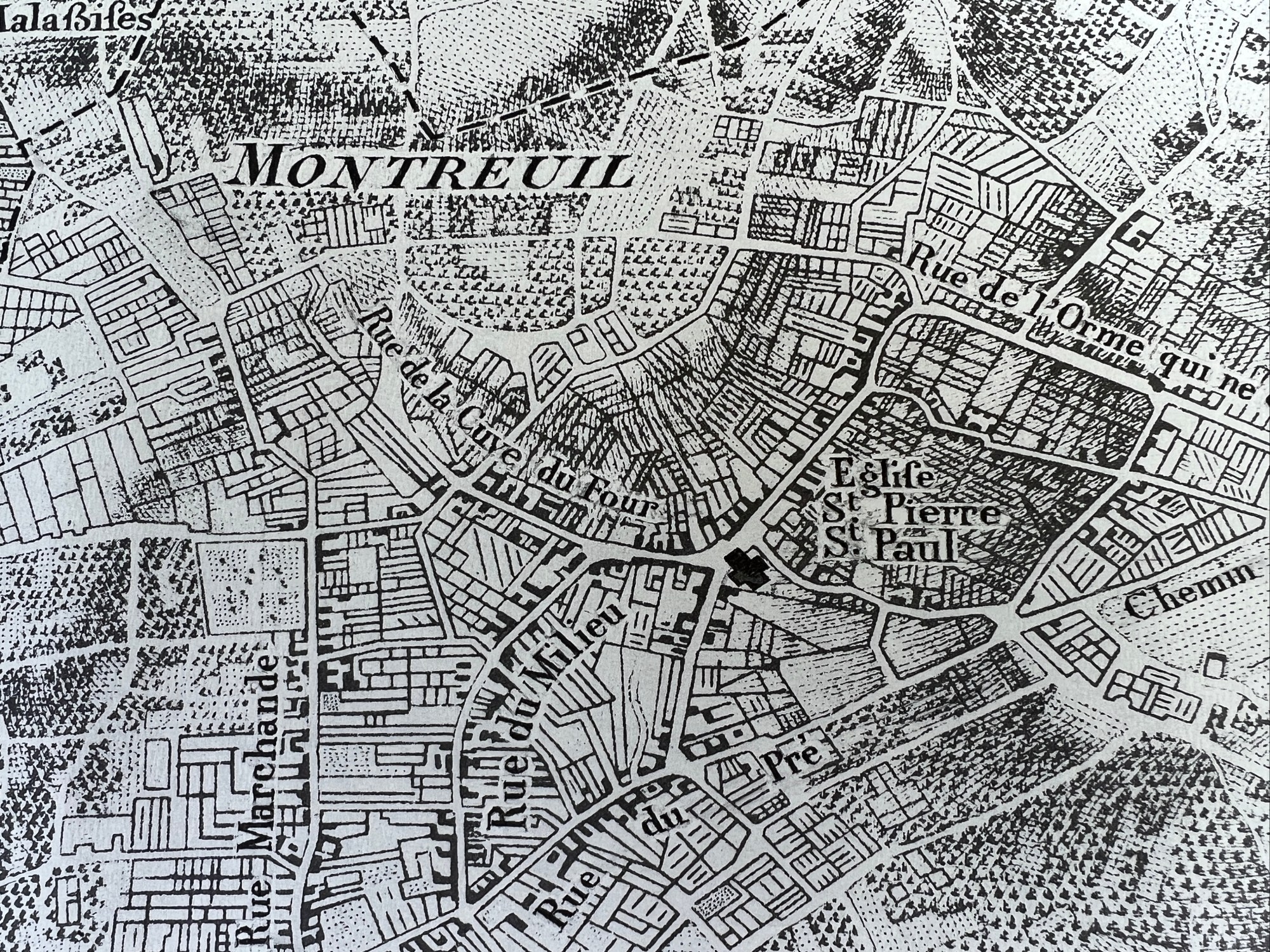
One thing that I wanted to do while staying in Paris this trip was to visit the town where Simon Savard, an ancestor, lived before he emigrated to Canada and started the line that went through my grandmother, on my father’s side. I mentioned Simon Savard in an earlier post, when I came across his entry in a book I spotted by chance at the Bibliothèque Nationale.
According to “Our French-Canadian Ancestors,” by Thomas LaForest, Simone Savard, a carriages-maker, purchased a house from his brother-in-law in 1650. The house was located in Montreuil-sur-Vincennes (today, Montreuil, or Montreuil-sous-Bois) on rue Cuve du Four (today, Alexis Lepère). With his wife and six children, Simon left Montreuil in 1663 for a new life in New France.
Montreuil is a suburb of Paris, reachable by Metro — that is, reachable by Metro on a non-strike day. We had to change our original plan and wait for a day when Metro workers were not striking, but on one of our last days in Paris, we visited the town.
Our first stop was the Mairie. There, we were ushered in to the office of the city archivist. He told us that he has met many Savards, visiting the town in search of ancestral roots. Most everything I would want to know, if it is available, is online, and he showed me where to find information. His colleague walked in to the office with a map of Montreuil as it appeared in Simon’s time. We looked at it, and when we were done, they rolled it up and gave it to me to take home.
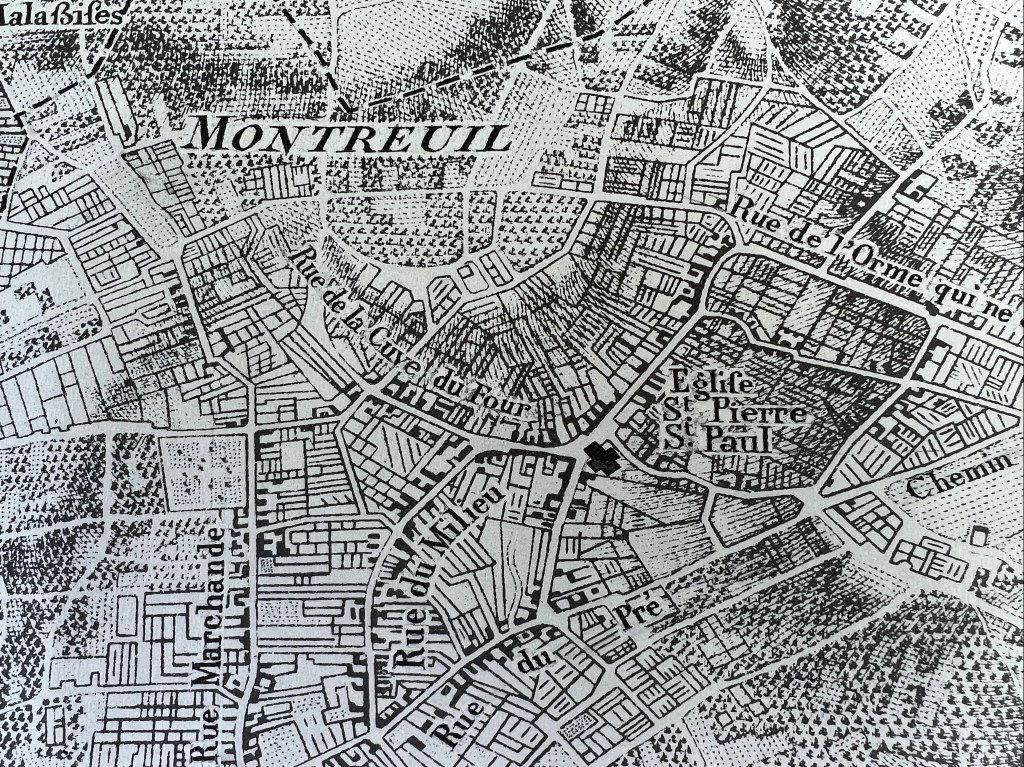
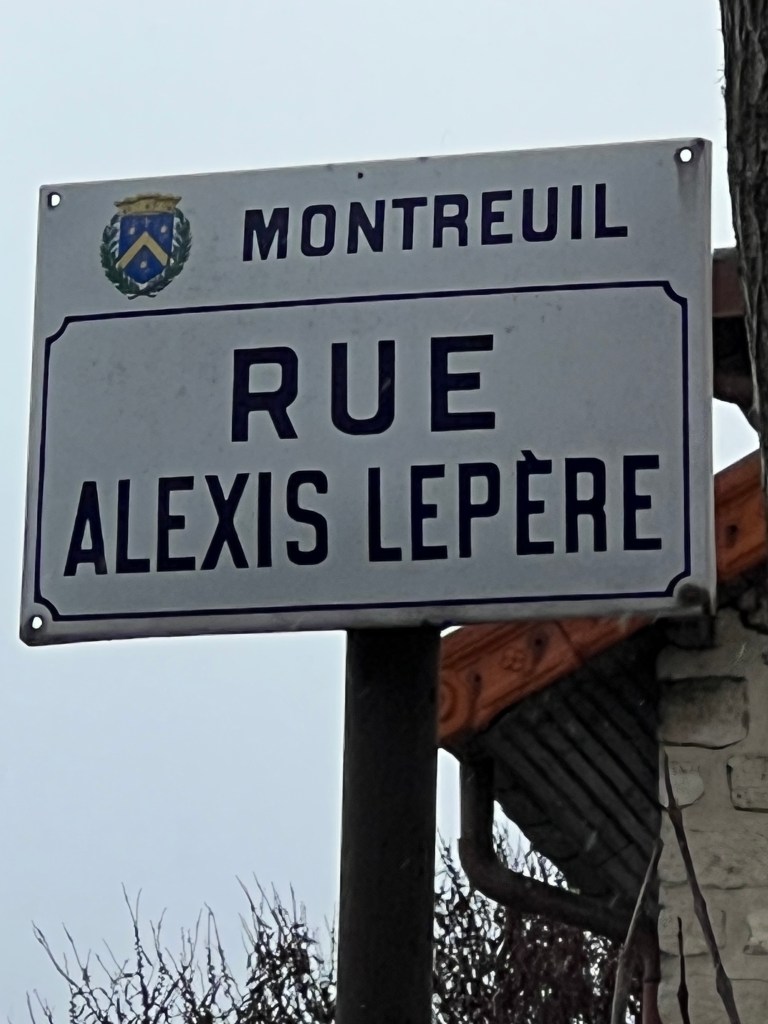
After leaving the mayor’s office, we went to visit L’Eglise Saint-Pierre, where Simon married Marie Hourdouille in June 1644. From the church, we walked along rue de l’Eglise, which becomes Alexis Lepère after a block. Except for its curving path, Alexis Lepère looks nothing like the old rue Cuve du Four, but it was fun to know that on one of these plots of land (I don’t know exactly which), my eighth great grandfather raised a family until he decided that life would be better elsewhere.



How did Simon make out in New France? According to “Our French-Canadian Ancestors,” he and his family, on the verge of starvation, were granted staples, clothing, blankets and other aid by the Sovereign Council in the late spring of 1664. His family survived, but Simon never recovered from something contracted on the voyage to Canada in a ship packed with 150 people. He died in the summer of 1664.
 Keeping up with Pat and Maurice